
Airway POCUS 360 Course
Original price was: ₨ 25,000.₨ 20,000Current price is: ₨ 20,000.
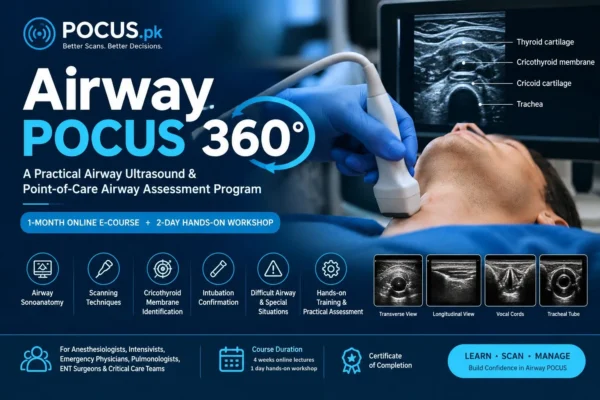
Airway POCUS 360 is a 1-month online + 1-day hands-on airway ultrasound course designed for clinicians involved in airway management. Learn airway sonoanatomy, systematic airway scanning, cricothyroid membrane identification, difficult airway assessment and ultrasound-assisted intubation confirmation.
Airway POCUS 360™
Complete Airway Ultrasound & Point-of-Care Airway Assessment Course
Learn how to use ultrasound to identify airway anatomy, assess difficult airways,
locate the cricothyroid membrane and support airway procedures.
Airway POCUS 360™ Course Overview
Airway POCUS 360™ is a practical airway ultrasound training course
designed for clinicians who want to develop a systematic approach to point-of-care
ultrasound for airway assessment and procedures.
The course combines a 1-month online e-course with a
1-day hands-on workshop. You will learn airway sonoanatomy,
systematic scanning, cricothyroid membrane identification, difficult airway
assessment and ultrasound-assisted confirmation of tracheal intubation.
Course Details
📚 Format: 1-Month Online E-Course + 1-Day Hands-On Workshop
📅 Online E-Course: November 22 – December 20, 2026
🩺 Hands-On Workshop: December 27, 2026
💰 Course Fee: Rs. 20,000
🎓 Level: Beginner to Intermediate
📱 Registration:
WhatsApp 0332-6656789
Who Should Attend?
Airway POCUS 360™ is suitable for healthcare professionals involved in airway
assessment, anesthesia, emergency care and critical care.
- Anesthesiologists
- Intensivists
- Emergency physicians
- Pulmonologists
- ENT surgeons
- Critical care fellows and residents
- Doctors involved in airway management
What Will You Learn?
By the end of the course, participants will be able to:
- Understand the basic principles, applications and limitations of airway ultrasound.
- Identify important anterior neck and airway structures using ultrasound.
- Perform a systematic ultrasound assessment of the upper airway.
- Identify the thyroid cartilage, cricoid cartilage, trachea and cricothyroid membrane.
- Use ultrasound to help locate the cricothyroid membrane before an airway procedure.
- Recognize common ultrasound appearances of airway structures.
- Use ultrasound as an adjunct when assessing selected difficult-airway situations.
- Understand ultrasound-assisted assessment of tracheal intubation.
- Acquire, save and document useful airway ultrasound images.
- Understand when airway ultrasound may be useful and when it should not replace standard clinical methods.
1-Month Online Airway Ultrasound E-Course
The online component takes you step by step from basic ultrasound principles
to practical airway applications and case-based learning.
Module 1: Introduction to Airway POCUS
- What is Airway POCUS?
- Clinical applications
- Advantages and limitations
- Role of ultrasound in airway management
- Ultrasound machines and probe selection
- Probe handling and orientation
- Image optimization
- Basic ultrasound terminology
Module 2: Airway Ultrasound Anatomy
- Tongue
- Hyoid bone
- Epiglottis
- Vallecula
- Thyroid cartilage
- Vocal cords
- Cricoid cartilage
- Trachea
- Cricothyroid membrane
- Pretracheal tissues
- Practical identification of airway structures
Module 3: Systematic Airway Scanning
- Patient positioning
- Choosing the appropriate probe
- Transverse scanning
- Sagittal scanning
- Identifying anatomical landmarks
- Basic airway measurements
- Saving and documenting images
- Common scanning mistakes
Module 4: Cricothyroid Membrane Ultrasound
- Relevant anatomy
- Identifying the thyroid and cricoid cartilages
- Locating the cricothyroid membrane
- Transverse and longitudinal approaches
- Measuring the cricothyroid membrane
- Pre-procedure marking
- Challenges in obesity and distorted anatomy
- Effect of neck positioning
- Common identification errors
Module 5: Ultrasound in Difficult Airway Assessment
- Limitations of external anatomical landmarks
- How ultrasound can supplement airway assessment
- Anterior neck anatomy
- Pre-procedure airway mapping
- Limited neck extension
- Obesity
- Neck edema and distorted anatomy
- Previous neck surgery
- Trauma-related airway challenges
Module 6: Ultrasound for Tracheal Intubation Confirmation
- Why confirmation of tracheal intubation matters
- Principles of ultrasound confirmation
- Transverse tracheal views
- Ultrasound appearance of the endotracheal tube
- Tracheal versus esophageal placement
- Dynamic assessment
- Common interpretation errors
- Clinical usefulness and limitations
- Relationship with standard confirmation methods
Module 7: Emergency Airway POCUS
- Airway ultrasound during emergency intubation
- Cardiac arrest scenarios
- Trauma
- Altered consciousness
- Respiratory failure
- Difficult airway situations
- Rapid ultrasound assessment
- Using POCUS as an adjunct to clinical decision-making
Module 8: Advanced Airway Sonoanatomy
- Detailed anterior neck anatomy
- Laryngeal sonoanatomy
- Vocal cords
- Arytenoid region
- Thyroid and cricoid relationships
- Tracheal rings
- Pretracheal structures
- Anatomical variations
Module 9: Special Airway Situations
- Pediatric airway considerations
- Obesity
- Neck masses
- Previous tracheostomy
- Post-surgical anatomy
- Cervical spine precautions
- Airway edema
- Airway trauma
Module 10: Ultrasound-Assisted Airway Procedures
- Airway landmark identification
- Pre-procedure ultrasound mapping
- Cricothyroid membrane localization
- Ultrasound assessment before tracheostomy
- Procedure planning
Case-Based Learning
The course includes practical clinical scenarios to help participants connect
airway ultrasound findings with real-world airway assessment and procedural
planning.
4-Week Learning Plan
| Week | Focus |
|---|---|
| Week 1 | Ultrasound fundamentals and airway anatomy |
| Week 2 | Airway assessment and cricothyroid membrane identification |
| Week 3 | Intubation confirmation and difficult airway applications |
| Week 4 | Advanced applications, special situations, cases and final assessment |
1-Day Hands-On Airway POCUS Workshop
The hands-on workshop focuses on supervised scanning and practical application.
Participants will work through structured stations covering normal anatomy,
airway landmarks, difficult-airway assessment and airway procedures.
- Equipment & Probe Handling – Probe selection, orientation and image optimization.
- Normal Airway Sonoanatomy – Identification of major airway structures.
- Transverse Airway Scanning – Systematic transverse scanning technique.
- Longitudinal Airway Scanning – Sagittal and longitudinal views.
- Cricothyroid Membrane Identification – Locate and mark the membrane using ultrasound.
- Difficult Airway Assessment – Apply ultrasound to selected challenging scenarios.
- Endotracheal Tube Confirmation – Recognize ultrasound findings associated with tracheal and esophageal placement.
- Dynamic Airway Assessment – Observe airway structures during relevant maneuvers.
- Case-Based POCUS – Practice ultrasound assessment using clinical scenarios.
- Practical Assessment – Demonstrate core airway ultrasound skills.
Why Airway POCUS 360™?
- Combines online learning with practical hands-on training.
- Focuses specifically on airway ultrasound applications.
- Includes systematic airway scanning techniques.
- Covers cricothyroid membrane identification.
- Includes difficult-airway and emergency scenarios.
- Provides supervised practical scanning experience.
- Includes case-based learning and practical assessment.
Course Fee: Rs. 20,000
1-Month Online E-Course + 1-Day Hands-On Workshop
Group of 3: 15% Discount
Group of 5: 25% Discount
Ready to Learn Airway POCUS?
For registration, course details or group enrollment, contact us on WhatsApp.
Register via WhatsApp: 0332-6656789
Email:
academy@pocus.pk
Educational Note: This course is intended for healthcare
professionals and provides educational training in airway point-of-care
ultrasound. Airway POCUS should be used as an adjunct to appropriate clinical
assessment, established airway management techniques and local clinical protocols.
Discover more from POCUS
Subscribe to get the latest posts sent to your email.

Reviews
There are no reviews yet.